
Whitepaper: Emotional Safety
Aug 08, 2026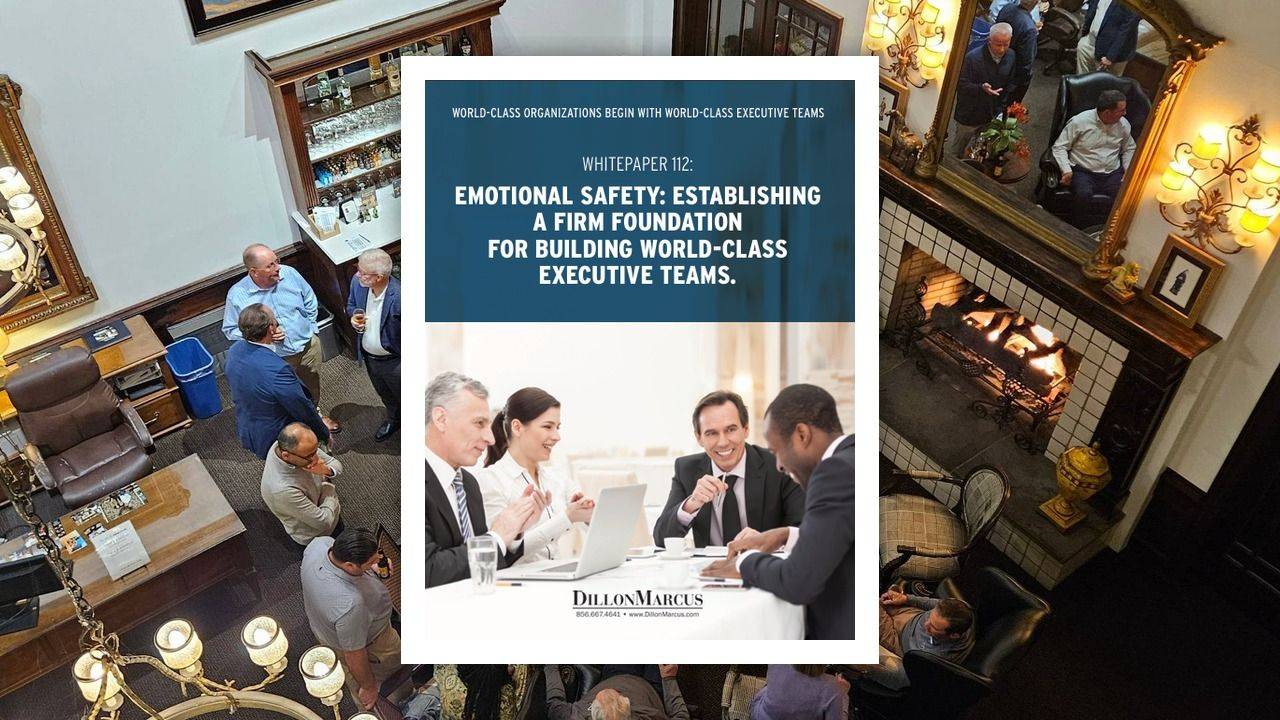
Conversations about emotional safety did not naturally come up when DillonMarcus was helping executive teams define who they are as a team, how they want to harness their collective influence, or how they want to treat one another. But over time, it became clear that emotional safety is the firm foundation everything else depends on.
How the Issue Surfaced
In the early stages of DillonMarcus's work, the team would interview each executive one-on-one during the discovery phase, ensuring their comments stayed anonymous and were only reported back to the President in aggregate. But during the retreat itself, every time a core topic came up for discussion, the room went quiet. Even with coaching, executives wouldn't speak honestly — they'd give just enough to participate, but no more.
Co-founder Tara Marcus finally identified the core issue: it wasn't safe. Most team members weren't going to advance any higher in the organization, and they were more interested in protecting their careers than in speaking up and challenging the leader.
What Google's Research Confirmed
Google's research on high-performing teams uses the term Psychological Safety, but DillonMarcus found that Emotional Safety is a more overarching and easier concept for people to understand. Google's recognition of the relationship between emotional safety and team performance gave DillonMarcus the confidence to bring the issue directly to executive team clients — even though they hadn't yet heard an executive spontaneously say they needed more emotional safety to perform at their best.
Too often, organizations are over-managed and under-nurtured. Leadership team members can be ripe with sarcasm, unconscious bias toward conformity, and an underlying fear of truly saying what's on their mind. As DillonMarcus developed its 0-to-60™ assessment, that pattern kept surfacing — including in a conversation with Chris Conroy, President & CEO of Holman Business Services, who immediately pointed to Emotional Safety as something he'd been working on in earnest with his team for two years.
Defining Emotional Safety
DillonMarcus defines Emotional Safety as being achieved when each member of the executive team is confident that the team will not embarrass, reject, or punish someone for speaking up. A "safe space" must be created where the overall team atmosphere is one of respect, and team members are encouraged to take risks.
Questions to Assess Your Team's Emotional Safety
Honest reflection can help you get a clear sense of the level of Emotional Safety on your leadership team. A few questions from the 0-to-60™ assessment worth discussing together: To what extent can all team members be honest and ask for help without fear of reprisal? How well do we consistently show sensitivity to each other's feelings and needs? On a scale of 1-10, does everyone agree it's emotionally safe to be part of this Executive Team?
Each member of the executive team should also ask personally: Do I feel emotionally safe on this team? And what am I willing to do to ensure that I am?
Why This Matters
The real value comes from sitting together and having a real, genuine, courageous conversation about these questions — the extent to which team members feel comfortable answering honestly is itself a gauge of the current level of Emotional Safety on the team. As organizations move away from cultures dominated by strong hierarchical structures, a new kind of leader is emerging, one whose role is creating the culture that truly unleashes people's talent, passion, and loyalty.
Frequently Asked Questions
How does DillonMarcus define Emotional Safety?
Emotional Safety is achieved when every executive team member is confident the team won't embarrass, reject, or punish them for speaking up, within a "safe space" built on respect.
How is Emotional Safety different from Google's Psychological Safety?
DillonMarcus finds Emotional Safety to be a more overarching and easier-to-understand term, though it points to the same relationship Google identified between team safety and performance.
How can a team assess its own level of Emotional Safety?
By discussing structured questions together as a leadership team — drawn from DillonMarcus's 0-to-60™ assessment — and by having each member honestly reflect on their own sense of safety.
Learn more about how DillonMarcus helps build world-class executive teams at DillonMarcus.com, or download the full Emotional Safety Whitepaper (PDF).
Back to Blog
